Beyond the Dashboard: Why AI Startups Need a New Approach to User Experience
AI startups are building increasingly intelligent products. AI agents can conduct research, automate business processes, communicate with customers, generate content, and coordinate complex workflows.
Yet while the intelligence behind these products continues to advance, the interfaces used to interact with them often remain surprisingly conventional.
A sidebar. A chat window. A table of agents. A collection of status indicators. Another dashboard.
For many AI products, the experience still resembles traditional enterprise software, even when the technology behind it is fundamentally different.
This raises an important question:
If AI is transforming what software can do, shouldn't it also transform how software feels to use?
As the AI market becomes increasingly competitive, user experience may become one of the most important ways for startups to differentiate their products.
And the next generation of AI interfaces could look very different from the dashboards we know today.
1. AI Products Are Becoming More Capable, but Their Interfaces Look Increasingly Similar
The rapid development of AI technology has created an extraordinary range of products.
Some help companies automate customer support. Others manage sales pipelines, coordinate marketing activities, conduct research, or operate networks of specialized AI agents.
Despite these differences, many share remarkably similar interface patterns.
Users interact with a central chat window, navigate between dashboard sections, configure agents through forms, and monitor activity through tables and logs.
These familiar patterns are not inherently bad. They make products accessible and reduce the learning curve.
However, they can also make fundamentally different AI products feel interchangeable.
When competing platforms offer similar capabilities and similar interfaces, communicating a distinctive product identity becomes increasingly difficult.
For AI startups, this creates an opportunity to reconsider user experience as part of the product itself, rather than simply a visual layer added after development.
2. The Problem With Designing AI Products Like Traditional SaaS
Traditional SaaS interfaces were largely designed around information management.
Users create records, update fields, review reports, and move between different sections of an application.
AI agents introduce a different type of interaction.
They perform tasks, make decisions within defined boundaries, communicate with other systems, and execute multi-step workflows.
In some cases, several agents may operate simultaneously.
A user managing these systems needs to understand more than individual data points.
They need to understand relationships.
Which agents are working together? Which workflows are progressing? Where is human approval required? What has changed since the last interaction?
A conventional dashboard can communicate these details, but often through multiple screens that users must mentally connect.
The challenge is no longer simply displaying information. It is helping people understand an active, interconnected system.
That requires a different approach to interface design.
3. From Managing Software to Experiencing a Digital Environment
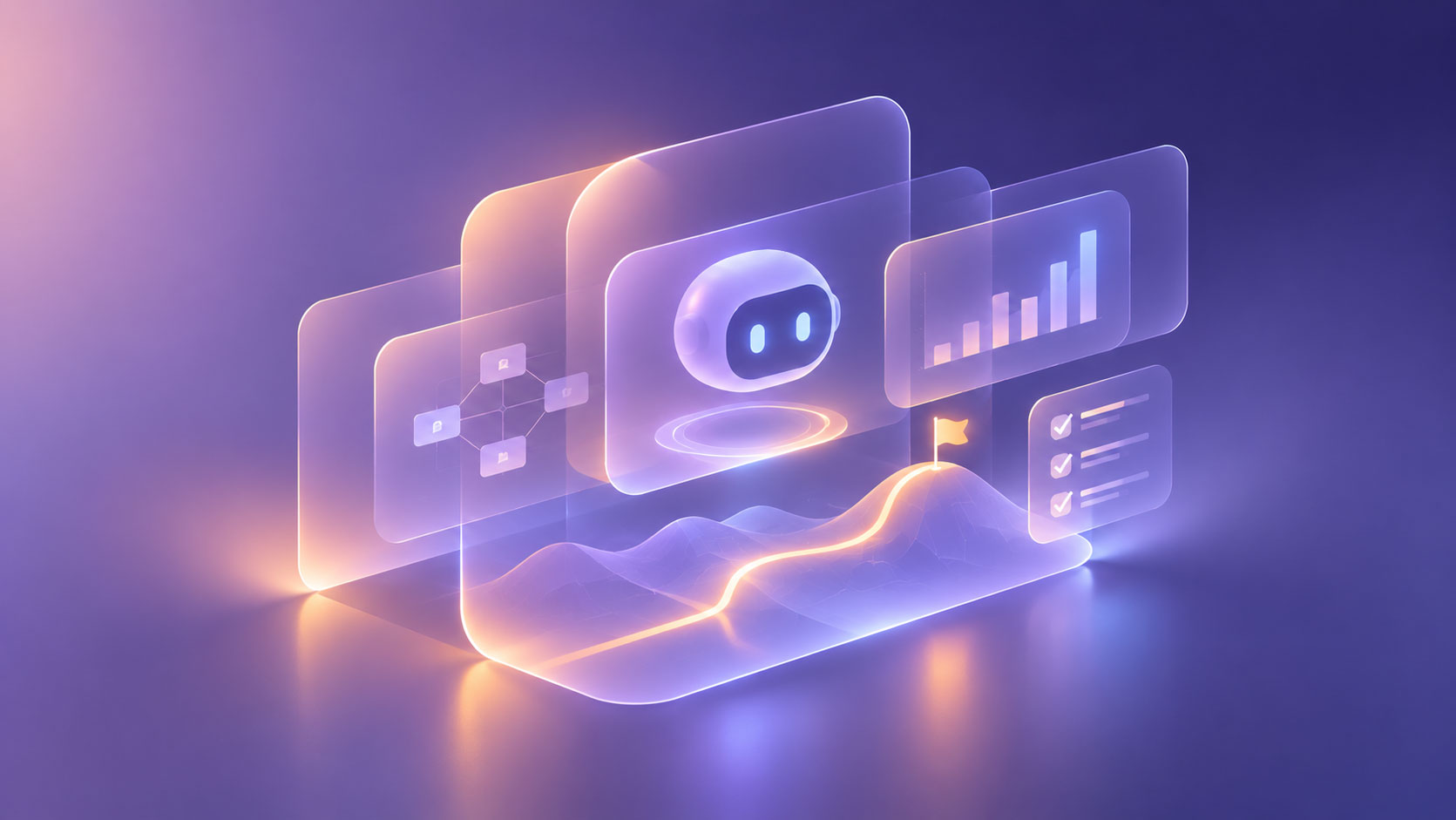
Imagine an AI platform where users do not begin with a list of agents.
Instead, they enter an interactive digital environment representing the organization or system they manage.
Different areas correspond to different functions.
A research department contains research agents.
A marketing space contains content creation and campaign automation agents.
A customer support area visualizes incoming requests and ongoing conversations.
Connections between these areas represent actual workflows.
Users can navigate the environment, select agents, inspect their activities, and intervene when necessary.
The experience becomes more spatial, visual, and intuitive.
Importantly, this does not mean replacing precise controls with decorative animations.
Detailed logs, configuration panels, and analytics remain accessible.
The interactive environment simply becomes another way to understand and operate the system.
This approach could be particularly valuable for AI platforms managing multiple agents, complex workflows, or human-AI collaboration.
4. Why Gamification Could Become an Important Part of AI User Experience
Gamification is often misunderstood as adding points, rewards, or competition to otherwise ordinary software.
But its potential extends much further.
Game design has developed sophisticated methods for helping users understand complex systems through visual feedback, progression, exploration, and interaction.
Consider strategy and simulation games.
Players manage resources, characters, buildings, objectives, and interconnected systems.
Yet well-designed games make this complexity understandable through visual organization and meaningful feedback.
These principles can also inform AI interface design.
For example:
- Agent identities: Recognizable visual representations help users distinguish different AI agents and their responsibilities.
- Interactive workflows: Complex automation sequences become visual journeys rather than disconnected technical processes.
- Progress visualization: Users can understand the status of tasks and objectives through meaningful environmental changes.
- Spatial organization: Departments, teams, and functions can occupy distinct areas within a shared interface.
- Immediate feedback: Important events become visible without requiring constant navigation between screens.
The goal is not to make professional software feel childish.
It is to apply proven interaction principles from games to make sophisticated technology easier to understand and more engaging to use.
5. Interactive 3D Websites Could Redefine AI Product Interfaces
Interactive 3D technology introduces another possibility.
Instead of treating the interface as a collection of flat pages, AI startups could develop navigable environments that represent their products.
Using web technologies such as WebGL and Three.js, these experiences can operate directly in modern browsers.
An AI management platform might use a miniature virtual headquarters.
A workflow automation product might represent processes as connected environments.
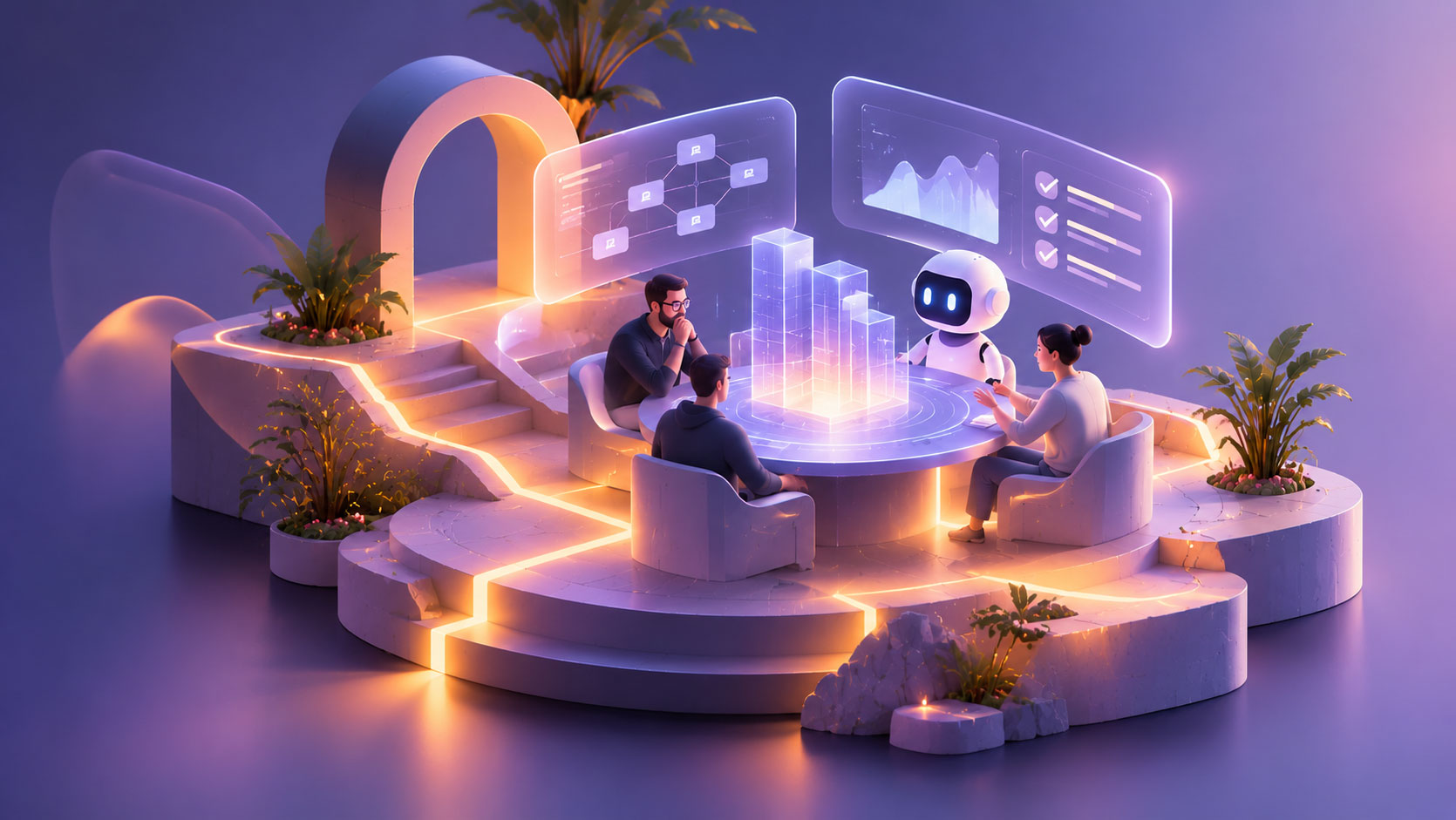
An AI collaboration platform could visualize employees and agents within a shared workspace.
A data intelligence product might use an explorable three-dimensional representation of interconnected information.
These experiences do not necessarily need photorealistic graphics or complex virtual worlds.
In many cases, a minimal, carefully designed 3D environment could communicate the concept more effectively.
The important consideration is usability.
Performance, accessibility, responsive behavior, and clear navigation must remain priorities.
An immersive interface should simplify the product, not make it more difficult to operate.
6. Why This Matters for AI Startups and SaaS Founders
For an early-stage AI startup, product differentiation is a significant challenge.
Technical capabilities evolve quickly, and competitors can introduce similar features.
A distinctive user experience can help communicate why a product is different.
There are several potential benefits.
Stronger Product Identity
A recognizable interactive environment can make an AI platform more memorable than a conventional dashboard.
Clearer Product Demonstrations
Visualizing agents and workflows can help prospective customers and investors understand what a product does without requiring extensive technical explanations.
More Intuitive Onboarding
Interactive guidance can help new users discover capabilities and understand relationships between different features.
Better Understanding of Complex Operations
Spatial representations and visual feedback can make interconnected workflows easier to follow.
Greater Opportunities for Engagement
Meaningful progression and interaction can encourage exploration and repeated use when they support real user needs.
These benefits are possibilities rather than guaranteed outcomes. They should be validated through prototypes and usability testing.
The strongest AI interfaces will not simply look different.
They will make difficult interactions genuinely easier.
7. You Don't Have to Rebuild Your AI Product to Transform Its Experience
One common misconception is that introducing a gamified or immersive interface requires rebuilding the entire application.
That is not necessarily the case.
Many AI startups already have functioning back-end systems, APIs, databases, and agent workflows.
An interactive experience can potentially be developed as a new front-end layer connected to those existing systems.
For example, an AI startup might retain its current agent infrastructure while introducing an interactive environment that visualizes agent status, tasks, workflow relationships, and available actions.
The underlying technology continues performing its existing functions.
The new interface changes how users experience and control those functions.
This creates an opportunity for startups to experiment with differentiated product experiences without necessarily replacing their core technology.
The feasibility depends on available integrations, permissions, performance requirements, and the architecture of the existing platform.
8. How Hybr Creative Can Help AI Startups Build More Engaging Products
At Hybr Creative , we specialize in gamified experiences, immersive interactive web environments, and interactive 3D design.
We see an opportunity to apply these capabilities to the next generation of AI-powered products.
For AI startups, SaaS founders, and companies developing custom AI agents, the challenge is not always creating more technology.
Sometimes, it is creating a better experience around the technology they already have.
Our approach focuses on translating complex digital systems into understandable, visually engaging, and interactive environments.
Potential projects include:
- Gamified AI agent dashboards.
- Interactive 3D workspaces.
- Visual workflow systems.
- Custom agent interfaces.
- Immersive product demonstrations.
- Interactive environments connected to existing AI systems.
Rather than beginning with visual effects, the process begins by understanding the product's users, workflows, and technical architecture.
From there, we can design an experience that reflects how the system actually works.
The objective is simple:
Make complex AI products easier to see, understand, navigate, and interact with.
Building an AI Product?
Your AI agents may already be powerful. We can help you explore how a gamified or immersive interface could make your product more distinctive and intuitive.
Discuss Your AI Project → Explore Our Services →9. The Future of AI Software May Be More Spatial, Visual, and Interactive
As AI agents become more autonomous and organizations adopt increasingly complex automation systems, interface design will face new challenges.
Users will need to understand multiple agents, interconnected processes, ongoing operations, and human responsibilities.
Traditional dashboards will continue to play an important role, particularly where precision and detailed analysis are essential.
But they may no longer be the only interface organizations need.
Interactive environments, spatial visualization, and gamification could introduce new ways to communicate complex systems.
Some products may benefit from lightweight visual dashboards.
Others may evolve into complete interactive digital workspaces.
The most successful approach will depend on the users, the tasks, and the complexity of the system.
The important shift is recognizing that AI software does not have to inherit every interface convention from the previous generation of SaaS.
Final Thoughts: The Next AI Innovation May Be the Interface
AI startups are investing heavily in building smarter agents, more capable models, and increasingly sophisticated automation systems.
But technological capability alone does not determine whether people understand, enjoy, or continue using a product.
User experience matters.
As the AI industry matures, companies that make powerful technology more accessible and intuitive may gain an important advantage.
Gamification and immersive interactive design offer promising directions for achieving this.
Not every AI platform needs to become a game.
Not every dashboard needs to become a virtual world.
But the next generation of AI products deserves interfaces designed around what AI systems actually do, rather than simply reproducing the software patterns of the past.
The future of AI will not only be defined by what intelligent systems can accomplish. It will also be defined by how people experience working with them.
Let's Design a Better Experience for Your AI Product
Whether you're building an AI agent platform, a SaaS product, or an internal AI workspace, Hybr Creative can help you explore gamification and immersive interactive design.
Start a Conversation → Explore a Gamified Experience → Visit Hybr Creative →