
AI Agents Are Getting Smarter. Their Dashboards Should Feel More Like Games.

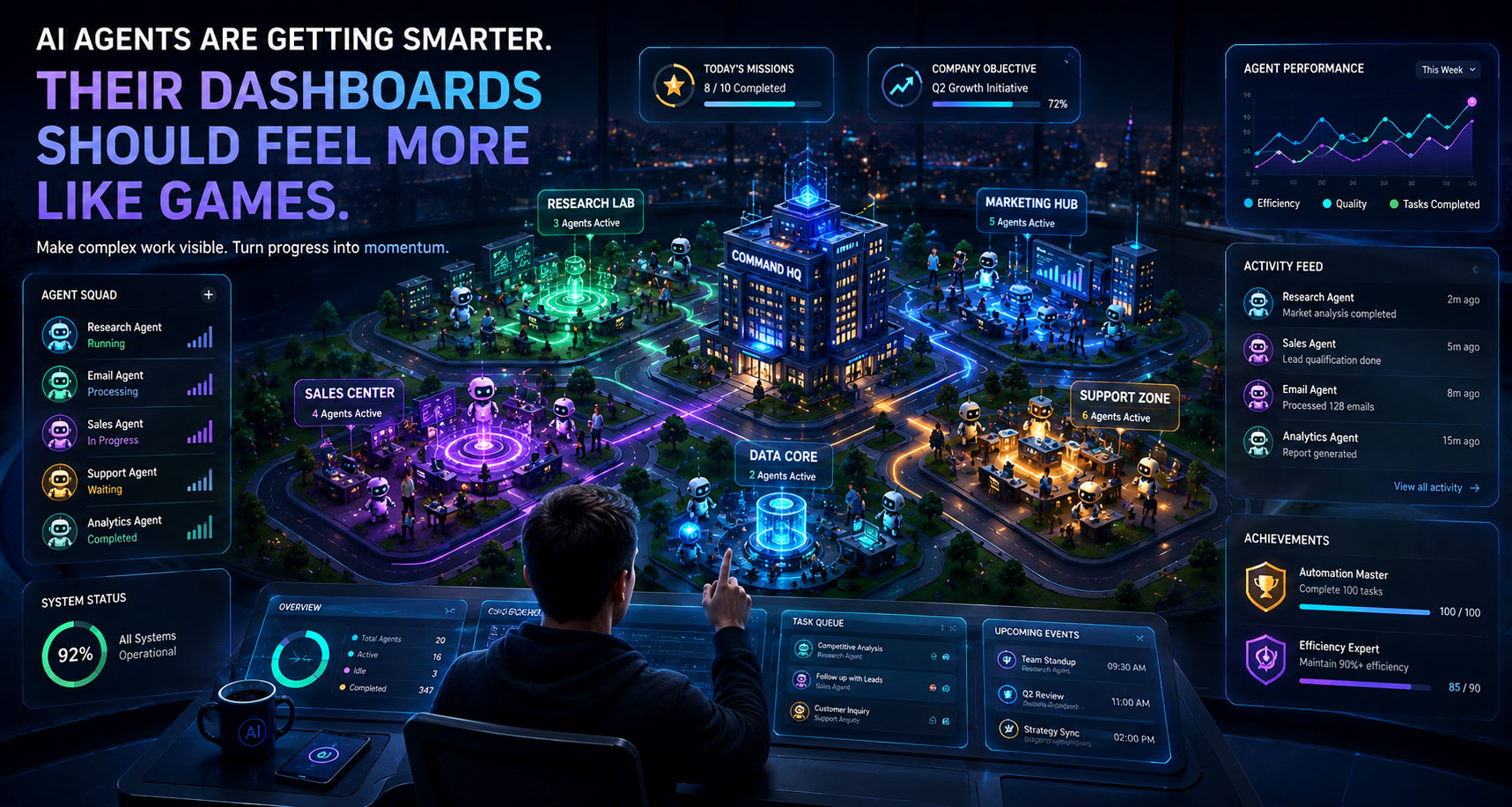
AI Agents Are Getting Smarter. Their Dashboards Should Feel More Like Games
AI agents are quickly becoming part of everyday work.
Companies are experimenting with agents that answer emails, research markets, qualify leads, organize documents, generate content, analyze data, schedule meetings, and automate repetitive operations.
The technology feels futuristic.
The interfaces often do not.
Open almost any AI agent dashboard and you are likely to find the same familiar structure: a sidebar, a list of agents, status indicators, task queues, activity logs, and configuration panels.
It works.
But if we are building a new generation of digital workers, why are we managing them through interfaces that still feel like traditional enterprise software?
There is an opportunity to rethink the AI agent dashboard entirely.
And gamification could be a surprisingly important part of it.
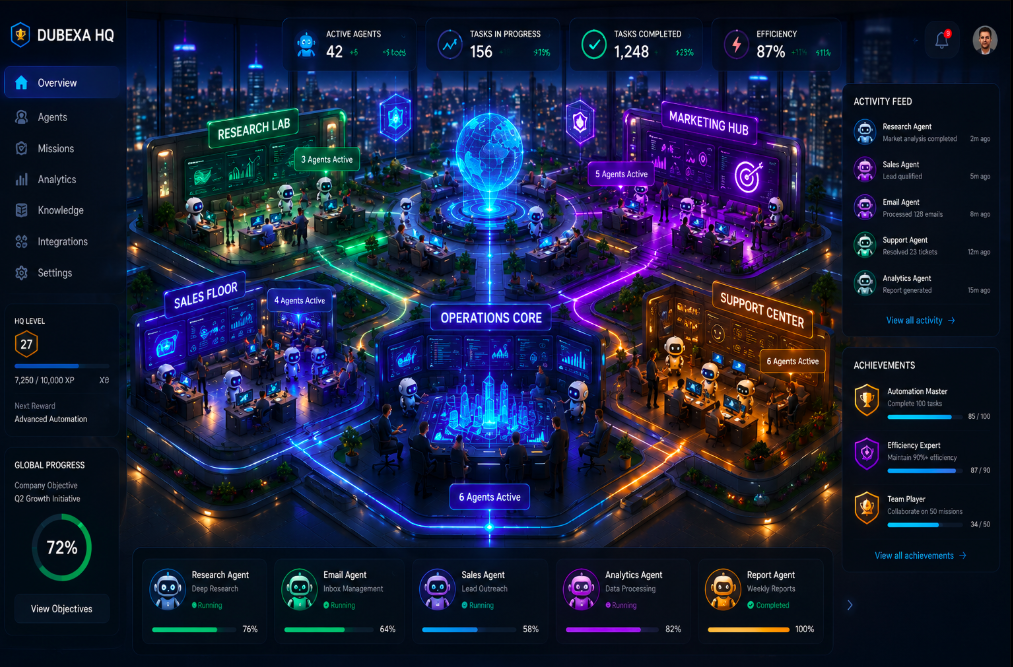
The AI Agent Dashboard Is Becoming a New Kind of Workplace
As organizations deploy more AI agents, managing them starts to resemble managing a small digital team.
One agent may handle customer inquiries. Another researches potential clients. Another monitors campaigns. Another prepares reports. Another organizes internal information.
Soon, the question is no longer simply, "What can this AI tool do?"
It becomes:
What is my team of agents doing right now?
Which agents are active? Which tasks are complete? Where are problems appearing? Which agent is performing well? What is happening across the organization?
At that point, the dashboard stops being a control panel for a piece of software.
It starts becoming a workspace.
That distinction matters.
Why Do AI Agent Dashboards Still Look Like Admin Panels?
Most software dashboards were designed around databases.
There are records, tables, statuses, charts, filters, and settings.
That makes sense when the user is managing information.
AI agents are different.
They perform actions. They have roles. They receive objectives. They move tasks through processes. They collaborate with humans and potentially with other agents.
Representing all of this as rows inside a table technically works, but it misses much of what makes agent-based software interesting.
Imagine opening your AI workspace and seeing:
- Email Agent — Running
- Research Agent — 3 Tasks
- Sales Agent — Waiting
Useful information, certainly.
But not particularly engaging.
Now imagine those same agents represented spatially inside an interactive workplace.
You immediately understand who is working, where activity is happening, which department is busy, what has been completed, and where your attention is required.
The underlying information can remain exactly the same.
The experience of understanding it becomes completely different.
What If Managing AI Agents Felt More Like a Strategy Game?
Strategy and simulation games have spent decades solving a problem enterprise software is only beginning to encounter:
How do you make a complex system understandable at a glance?
A strategy game may contain hundreds of simultaneous activities.
Resources are moving. Characters are working. Buildings are developing. Objectives are progressing. Problems appear. Rewards are unlocked.
Yet good game interfaces make these systems understandable because information is represented visually and spatially.
That principle could translate remarkably well to AI agent management.
Imagine each department as a space.
Marketing agents operate in one area. Sales agents operate in another. Customer support has its own environment. Operations occupies another.
Agents visibly move between states as they receive and complete tasks.
Important events appear naturally within the environment.
Instead of simply reading your company's AI activity, you could observe it.
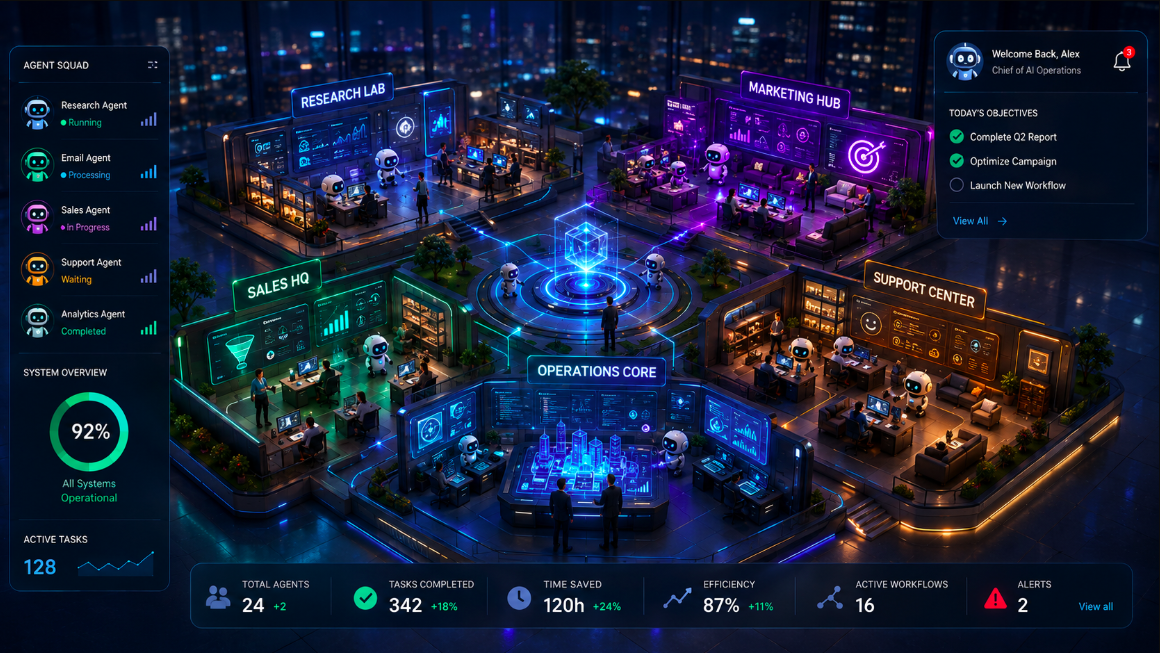
Gamification Doesn't Mean Turning Work Into a Toy
There is an important distinction here.
Gamifying an AI workspace does not mean adding meaningless points, cartoon characters, or leaderboards to every task.
Good gamification is about making systems easier to understand and more satisfying to interact with.
Progress is visible. Objectives are clear. Actions produce feedback. Achievements have meaning. Complex systems become easier to navigate.
In an AI agent dashboard, that could mean representing completed objectives as visible progress, showing agent activity through animation, turning workflows into journeys, or allowing departments to develop as automation expands.
The interface becomes a visual representation of what is actually happening inside the organization.
Your AI Agents Could Have Roles, Spaces and Progress
Once AI agents are treated as participants within a workspace rather than API processes hidden behind buttons, many interesting interface possibilities appear.
An organization could have a digital headquarters.
Inside it are different departments.
Inside those departments are specialized AI agents.
A sales agent might move through prospecting, qualification, outreach, and follow-up states.
A marketing agent might research trends, prepare content, monitor campaigns, and report results.
A customer service agent could visibly process incoming requests while escalating selected conversations to human employees.
You would still have access to detailed logs, analytics, and controls.
But those tools would exist underneath a more intuitive visual layer.
Think of it as two interfaces simultaneously:
the world for understanding and the dashboard for control.
Human Employees Could Exist in the Same Environment
This becomes even more interesting when human employees and AI agents share the same workspace.
Instead of separating "AI tools" from "employees," the interface could show how work actually moves between them.
An AI research agent completes an analysis.
A human strategist reviews it.
Another agent converts the approved direction into campaign variations.
A human creative director selects an approach.
A reporting agent later measures the outcome.
The interface becomes a map of collaboration.
This could make AI adoption easier because employees would not need to think about AI as an invisible technical layer operating somewhere in the background.
They could see where AI participates in their workflow.
Gamification Could Make Agent Performance Easier to Understand
There is another advantage: visibility.
Traditional dashboards can display performance metrics, but they often require users to actively interpret charts and tables.
A gamified environment could communicate some of the same information through the state of the workspace itself.
A department could visibly become more active when workload increases.
An agent requiring approval could signal for attention.
Completed objectives could change parts of the environment.
New capabilities could appear when additional agents are deployed.
Long-running organizational goals could have persistent visual progress.
This creates something dashboards often lack:
a sense of movement.
You can see that the organization is doing something.
AI Agents Need Better Identity
There is also a surprisingly important design problem emerging around agent identity.
If a company eventually operates 20, 50, or 100 specialized agents, names inside a dropdown may not be enough.
People need mental models.
"This is our lead research agent."
"This one manages customer follow-ups."
"That agent prepares our weekly reports."
Visual identity, location, role, and behavior can help employees understand the capabilities of different agents much faster.
Games already do this exceptionally well.
Characters are differentiated through appearance, position, abilities, and behavior.
AI interfaces could borrow the principle without copying the aesthetics of games directly.
From SaaS Dashboard to Digital Organization
This may ultimately be the bigger opportunity.
AI agents could change what business software looks like.
For the last decade, SaaS products have largely been collections of screens.
- Dashboard
- Projects
- Analytics
- Settings
- Users
AI agents introduce entities that act independently inside those systems.
Once software contains dozens of autonomous actors performing tasks continuously, representing everything through static screens becomes increasingly limiting.
The interface may need to become more spatial, visual, and alive.
Instead of opening software, you might enter your organization.
Instead of navigating between tools, you move between departments.
Instead of checking whether an automation ran, you see the agent responsible for it.
Instead of configuring isolated workflows, you orchestrate a digital workforce.
That starts to look much closer to a simulation environment than a traditional SaaS dashboard.
The Best AI Workspace May Be Somewhere Between Slack, a Dashboard and a Strategy Game
AI agent platforms do not need to literally become games.
But they can learn from them.
The ideal interface could combine the communication of a collaborative workspace, the precision of an enterprise dashboard, and the visual clarity and feedback systems of a strategy game.
Detailed information remains available when needed.
But the top layer becomes intuitive.
You see your organization.
You see your agents.
You see your people.
You see what is happening.
And you understand where your attention is needed.
A New Direction for Interactive Workspaces
At Hybr Creative, we are particularly interested in this intersection between gamification, interactive environments, and emerging workplace technology.
The same principles used to make games and interactive experiences engaging — progression, spatial understanding, feedback, identity, discovery, and participation — could influence how the next generation of AI-powered software is designed.
As AI agents become more capable, the challenge will no longer be only building better agents.
It will also be building better environments for humans to work with them.
This connects closely to our broader exploration of gamified organizational systems, where complex workplace activity can be represented through more visual and participatory interfaces.
Final Thoughts
AI agents are introducing an entirely new layer to digital work.
Yet we are still placing them inside interfaces designed for traditional software.
That feels temporary.
As organizations begin managing larger networks of AI agents alongside human employees, dashboards will need to communicate activity, relationships, progress, and responsibility in more intuitive ways.
Gamification offers one possible direction.
Not because work needs to become a game.
Because games have become remarkably good at helping humans understand and interact with complex, living systems.
Perhaps the future AI workspace will not look like another dashboard.
Perhaps it will look like a world you can actually run.
Explore Hybr Creative →
See a Gamified Organizational Experience →
Related Articles





HYBR
Creative

