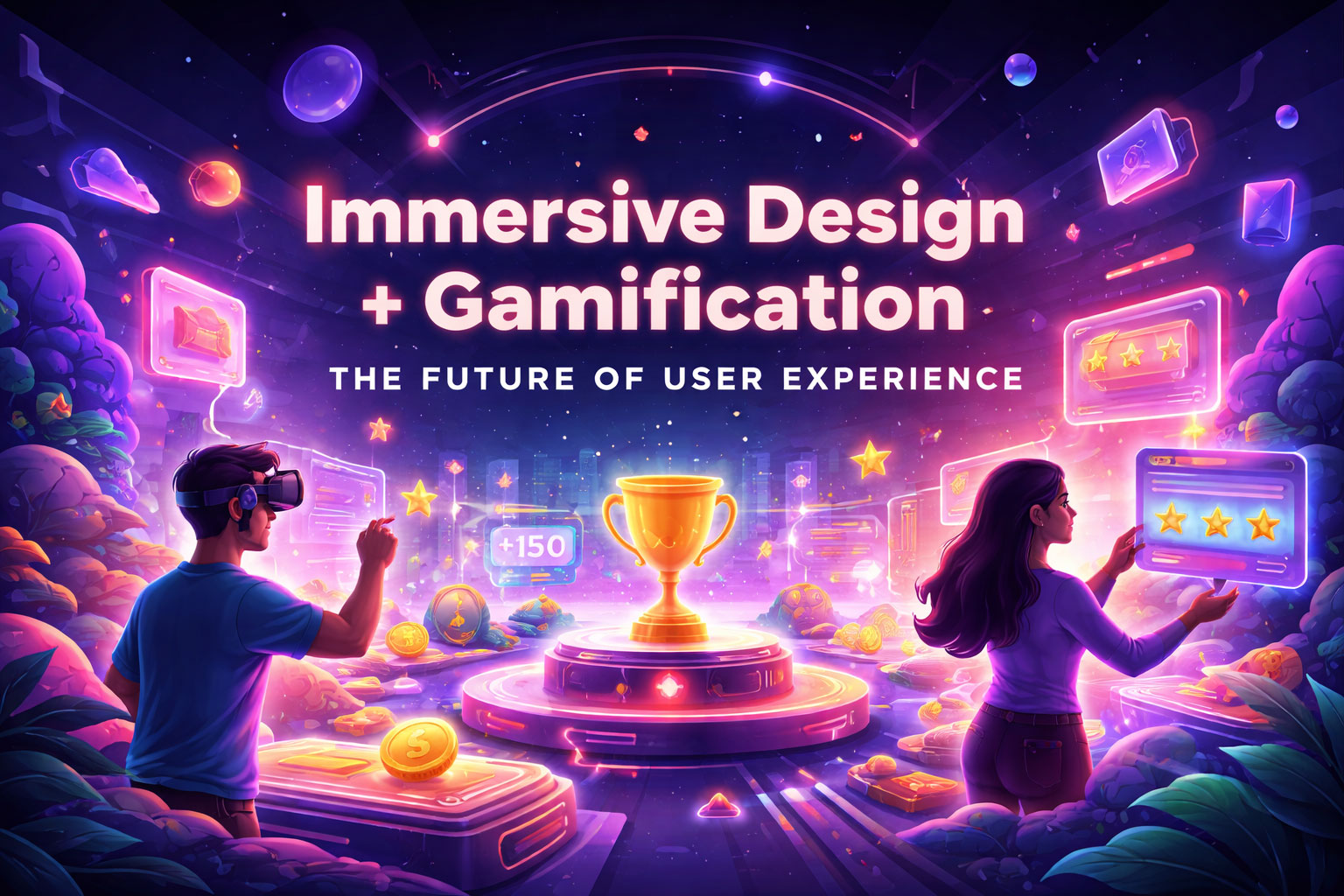
Immersive Design + Gamification: The Future of User Experience
A deep shift from passive interfaces to interactive digital worlds is redefining how brands connect with users.
For decades, user experience design has been centered around clarity, usability, and efficiency. The goal was simple: make digital products easier to use. Navigation became smoother, interfaces became cleaner, and interactions became faster.
But today, we are entering a fundamentally different era.
Users are no longer impressed by usability alone. They expect more. They expect emotion, interaction, and meaning. In a digital landscape saturated with similar layouts, templates, and predictable journeys, the brands that stand out are those that go beyond interfaces and create experiences.
This is where two powerful forces converge: immersive design and gamification. Together, they are shaping what we can define as the next generation of user experience.
The Evolution of User Experience
Traditional UX design has always been about solving problems. How quickly can a user find information? How easily can they complete an action? How intuitive is the interface?
While these questions are still important, they are no longer enough. The digital environment has evolved into a space where attention is limited and competition is constant. Every brand, every platform, and every product is fighting for the same few seconds of user focus.
As a result, experience has become the new differentiator.
Instead of asking “How usable is this?”, forward-thinking brands are now asking:
- How memorable is this experience?
- How long does the user stay?
- Do they come back?
- Do they feel something?
This shift marks the transition from functional UX to experiential UX.
What Is Immersive Design?
Immersive design is the practice of creating digital environments that users can explore rather than simply navigate. It transforms the screen into a space, and interaction into movement.
Instead of clicking through pages, users move through scenes. Instead of reading content, they discover it. Instead of following a linear path, they experience a narrative.
Technologies such as WebGL, 3D rendering, real-time animation, and spatial interaction have made it possible to bring these environments directly into the browser.
The result is a new kind of digital presence—one that feels closer to a world than a website.
A strong example of this approach can be seen in immersive brand platforms like:
Explore Eidos Photography ExperienceIn such experiences, the user is not just visiting a website—they are stepping into a brand universe.
The Role of Gamification in Modern UX
Gamification introduces a different layer entirely. While immersive design focuses on space and interaction, gamification focuses on behavior.
By integrating elements such as challenges, progression systems, rewards, and feedback loops, gamification transforms users from passive viewers into active participants.
These mechanics are not random. They are rooted in psychology:
- The desire for achievement
- The motivation to progress
- The curiosity to explore
- The satisfaction of reward
When applied correctly, gamification increases:
- Engagement time
- User retention
- Interaction depth
- Emotional connection with the brand
This is particularly effective in brand storytelling experiences such as:
View Najwa Jewels Gamified ExperienceWhere Immersion and Gamification Converge
Individually, immersive design and gamification are powerful. Together, they redefine the entire structure of digital interaction.
When combined, they create systems where:
- The environment becomes interactive
- The journey becomes dynamic
- The user becomes a participant
Instead of navigating a website, users move through a narrative space with objectives, discoveries, and outcomes. Every interaction contributes to a larger experience.
This convergence transforms digital platforms into interactive ecosystems—a shift that is already influencing how brands design their presence online.
Industry Applications
The impact of immersive gamified UX is not limited to one sector. It is being adopted across industries where engagement and differentiation are critical.
Real Estate: Interactive environments allow users to explore developments, understand value, and emotionally connect with spaces before visiting them physically.
Luxury Retail: Brands can present products within narrative worlds, turning browsing into discovery and storytelling.
Tourism and Culture: Digital experiences can reflect identity, heritage, and place in ways that static content cannot achieve.
Corporate and HR: Gamified systems are being used to increase employee engagement, learning, and collaboration.
Cultural storytelling experiences like QADIM demonstrate how immersive branding can connect deeply with identity:
Explore QADIM ExperienceFrom Engagement to Intelligence
Beyond engagement, immersive gamified experiences generate valuable insight.
Every interaction—every click, movement, or decision—becomes a signal. Unlike traditional analytics, these signals are richer, behavioral, and context-driven.
This enables brands to:
- Understand user intent more deeply
- Personalize experiences dynamically
- Optimize campaigns based on real behavior
In this sense, UX evolves into both an experience layer and a data intelligence system.
What Comes Next?
The future of user experience is not about more features or faster interfaces. It is about creating environments where users feel involved, engaged, and connected.
As immersive technologies continue to evolve and user expectations rise, static digital experiences will become increasingly obsolete.
The brands that lead this transition will not just capture attention—they will build lasting relationships.
Immersive design and gamification are not trends. They are the foundation of the next generation of digital interaction.
Build the Next Generation of User Experience
Explore how immersive storytelling and gamified interaction can transform your brand.
Discover Hybr Creative